
Passphrase Generator
A passphrase made of several truly random words is easier to remember and type than a jumble of symbols, and just as hard to guess. This generator picks words with your browser’s cryptographic random number generator — nothing is sent anywhere — and shows exactly how strong each passphrase is.
- Free to use
- No sign-up
- Runs in your browser
Passphrase generator
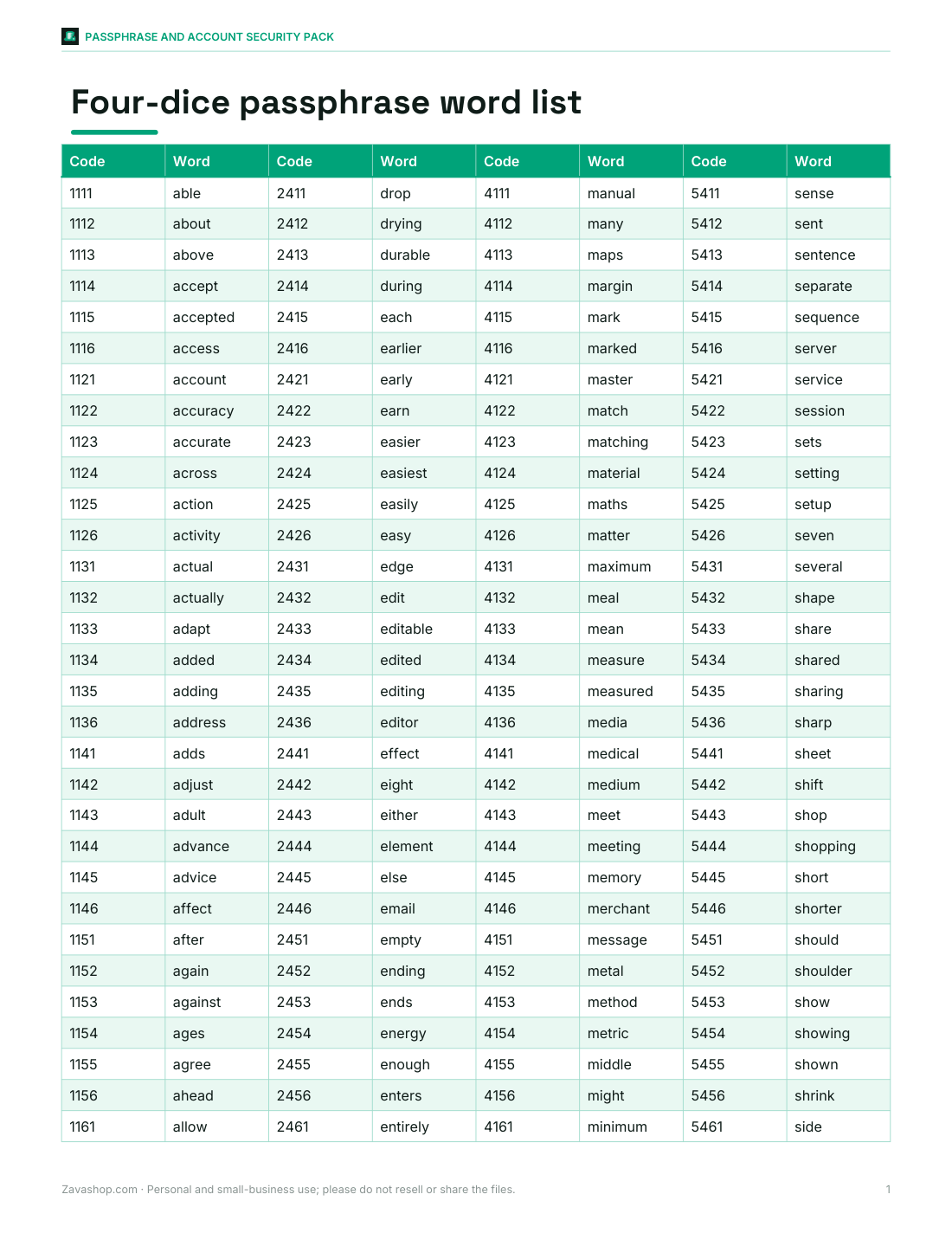
Offline: roll four dice
Passphrase and Account Security Pack
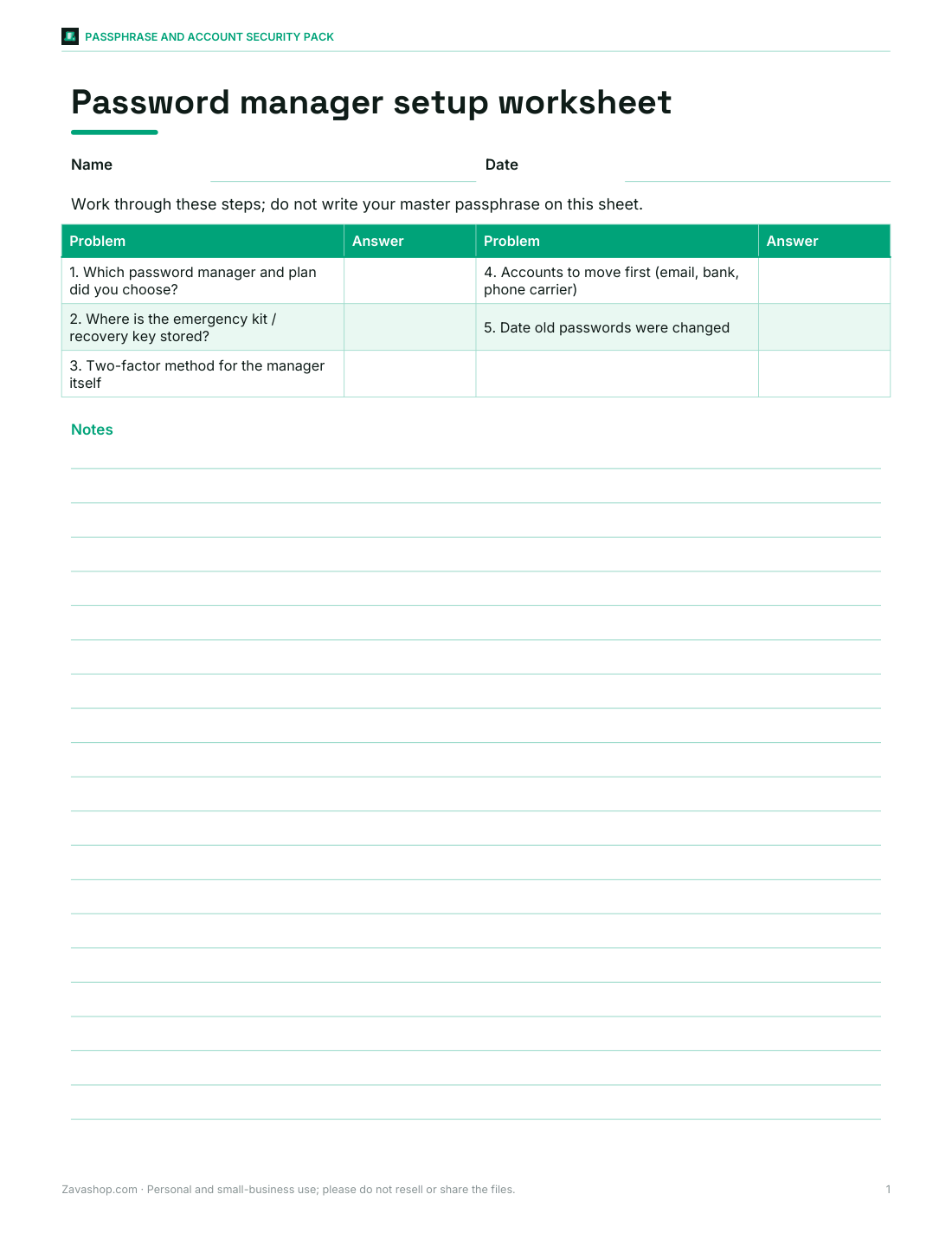
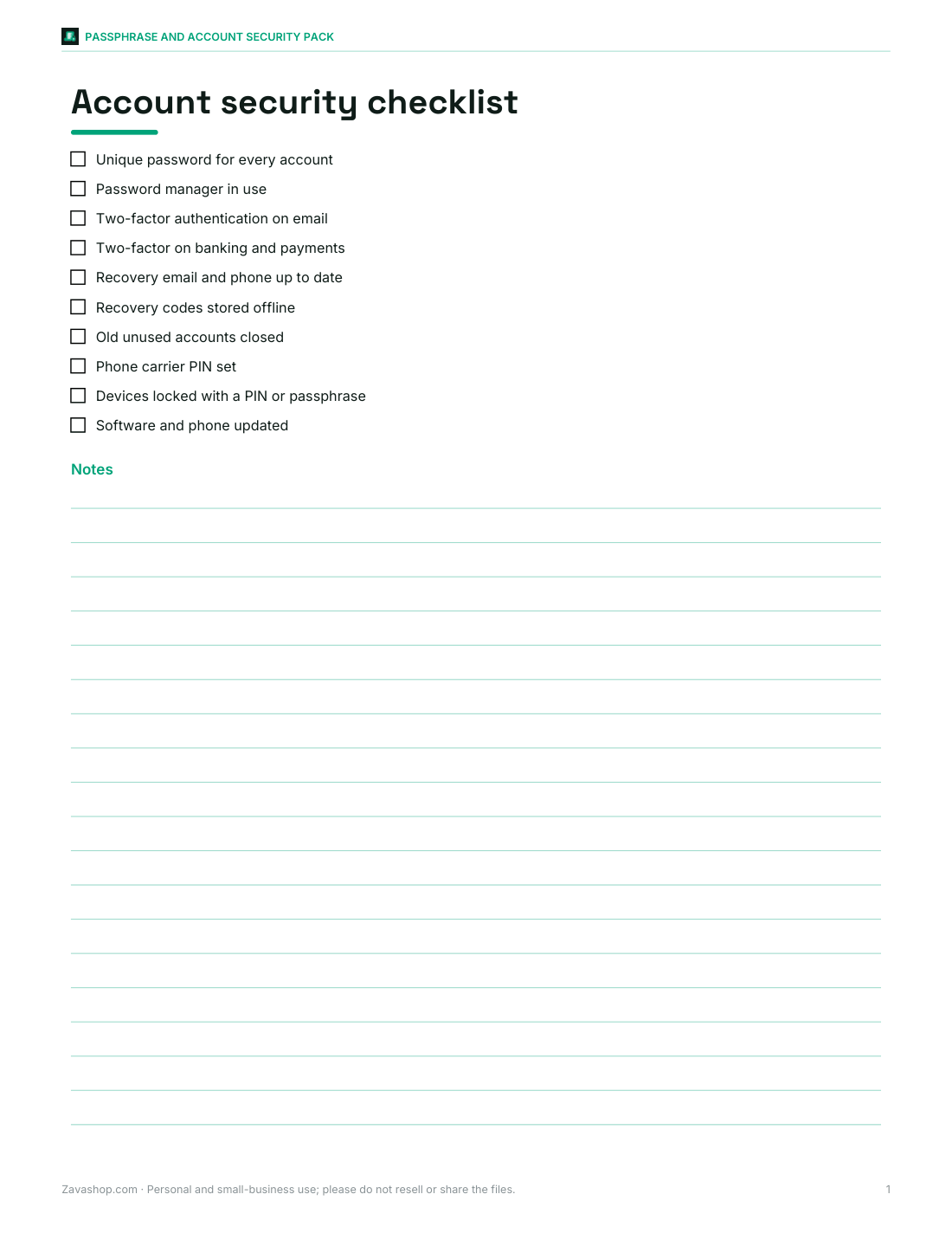
Printable 1,296-word dice list for offline passphrases, a password manager setup worksheet, an account security checklist, an account inventory sheet (no passwords) and a digital-legacy planning sheet.
- Dice word list (PDF)
- Manager setup (PDF/DOCX)
- Security checklist (PDF/DOCX)
- Account inventory (PDF/DOCX/XLSX)
- Digital legacy (PDF/DOCX)
Formats: PDF, DOCX, XLSX. Instant download after payment (link valid 72 hours, up to 5 downloads). AI-assisted: the templates were drafted with AI help and reviewed and laid out before publishing.
$5.00 USD, one-time 5 files · about $1.00 each
- Instant download
- 7-day refund
- Secure checkout by Stripe
7-day money-back guarantee. Full refund within 7 days of purchase, even after you download.
Free sample: Dice Word List (PDF, 94 KB)
Full refund within 7 days — see the refund policy and license.
Free printables
Single sheets you can print right now, no sign-up. The full pack adds every sheet in one download plus the editable files.
 Printable Four-Dice Passphrase Word List
 Printable Password Manager Setup Worksheet
 Printable Account Security Checklist
 Printable Account Inventory Sheet
 Printable Digital Legacy Planning Sheet
How strong is a passphrase?
| Words | Entropy (4,096-word list) | Entropy (1,296-word dice list) | Typical use |
|---|---|---|---|
| 4 | 48 bits | 41 bits | Low-value accounts only |
| 5 | 60 bits | 52 bits | Everyday accounts |
| 6 | 72 bits | 62 bits | Email, banking (with 2FA) |
| 7 | 84 bits | 72 bits | Password manager master password |
| 8 | 96 bits | 83 bits | Disk encryption, long-term secrets |
Each word chosen at random from 4,096 adds exactly 12 bits: every extra word makes the passphrase 4,096 times harder to guess. Length of the words themselves doesn’t matter — only how many random choices were made.
Why random words beat clever passwords
Human-chosen passwords follow patterns — capital first letter, a word, a year, an exclamation mark — and password-cracking tools try those patterns first. A passphrase like “Summer2024!” is weak however long it looks. Randomly chosen words have no pattern to exploit: the only way to find one is to try combinations from the word list, and six words from 4,096 gives about 4.7 × 10²¹ possibilities. Just as important, a string of words is easy to remember and to type on a phone.
Worked example
With the default settings — six words, hyphens, no capitals — each passphrase has 72 bits of entropy. At 100 billion guesses per second, the kind of speed a well-equipped attacker might reach against a fast, poorly protected password hash, finding it would take on average about 750 years. Against a site that uses a slow, modern hash such as bcrypt or Argon2, the attack is millions of times slower still. Adding a random digit adds a few more bits (5.9 bits for 6 words), which helps with sites that insist on a number.
Rolling dice for an offline passphrase
- Take four ordinary six-sided dice (or roll one die four times).
- Read them in order, for example 3-1-4-1, to get a four-digit code.
- Look the code up in the printable dice word list from the pack, or type it above.
- Repeat for each word you need — six or seven words is a good target.
- Write the passphrase down until you have memorised it, then store the note safely or destroy it.
Dice are a trustworthy source of randomness you can see with your own eyes — useful for a master password you never want to generate on a computer.
Password managers and the one passphrase to remember
The safest everyday setup is a password manager that creates and stores a long random password for every site, protected by one strong passphrase you memorise. That master passphrase is the one place where a seven- or eight-word passphrase really matters: if someone got a copy of your encrypted vault, it is the only thing standing between them and every account. Practise typing the new passphrase several times a day for the first week, and keep a written copy in a safe place until it sticks.
Sites with password rules
Some sites still demand an uppercase letter, a number and a symbol, or cap the length. The options here cover most of those rules: capitalise the first letter of each word, add a random digit, and use a hyphen or dot as the separator. If a site limits passwords to something short like 16 characters, use a four-word passphrase without separators only as a last resort — or better, let your password manager generate a random string for that site.
Using passphrases well
- Use a different password for every account; a password manager makes this practical.
- Use a passphrase for the few things you must remember: your password manager, your computer login, your email.
- Turn on two-factor authentication wherever it’s offered.
- Never reuse a passphrase shown in an example or tutorial — including this page’s.
- If a site limits length or characters, let your password manager generate a random password for it instead.
About the word list
The generator uses 4,096 common English words of four to eight letters, compiled from everyday vocabulary on our pages, with plurals of other listed words and potentially upsetting words removed. The dice list is the 1,296 most common of those words. Words are chosen with crypto.getRandomValues — the browser’s cryptographically secure random number generator — using rejection sampling so every word is equally likely.
What’s in the template pack
- Printable dice word list (1,296 words with four-dice codes)
- Password manager setup worksheet
- Account security checklist (2FA, recovery email and phone, recovery codes)
- Account inventory sheet — records where you have accounts, never the passwords
- Family digital-legacy planning sheet
The generator is free; the pack is a one-time download.
Privacy
Passphrases are generated in your browser and never sent to our server or anyone else. Nothing is stored.
Frequently asked questions
How many words should a passphrase have?
Six or more for important accounts; seven or eight for a password manager or encryption.
Is a passphrase better than a password?
A random passphrase is as strong as a random password of similar entropy and much easier to remember and type.
Are these passphrases really random?
Yes — they use your browser’s cryptographic random generator.
Do spaces or capitals make it stronger?
Only slightly; strength comes mainly from the number of random words.
What is entropy?
A measure of unpredictability in bits; each extra bit doubles the number of guesses needed.
Can I use dice instead of a computer?
Yes — roll four dice per word and look up the code in the dice list.
Should I use a passphrase from this page?
Generate your own and don’t reuse any example you see written down.
Is anything sent to your server?
No, everything happens on your device.